Hospitals are a place where 'health' is defined, and in doing so, the concept of 'unhealth(iness)' is also created. What is considered 'unhealthy' is hidden behind the walls of the hospitals and numerous medical procedures are performed and medicine and vaccines are administered for the fantasy of achieving a perfectly healthy body. This body is sometimes tested in the hospital during the day, turned inside out in the emergency room at night, and walks around the town connecting the fragments of the hospital.
How can we rediscover the way our patient's bodies perform in this society, a society that has endlessly disinfected, broken apart, recorded and transformed the body under the illusion of complete health?
Part 1. 입원Admission
Online performance, HAU 4 Digital Theater Single channel video, 7:09 mins
Hospital Trilogy explores the body within three distinct spatial structures of the stage— digital theater, traditional black box, and white cube gallery. Part 1.Admission, was performed as part of a Raumstrategien group project at HAU4 Digital theatre during the pandemic, rethinking what performance and the performative can mean when the theater has no physical stage.
In Admission, the viewer’s body is reinterpreted as both the diagnosing doctor and the diagnosed patient. The theater, the hospital, and the body—while distinct places in the real world— are substituted by the same pixels in the digitised online setting. In this metaphorical space, the ‘viewer’ in front of the screen becomes the body of the patient that is being diagnosed and treated.
Part 2. 재활Rehabilitation
Performance on Stage, Berliner Ringtheater, APAL@AmnAsia,12 mins
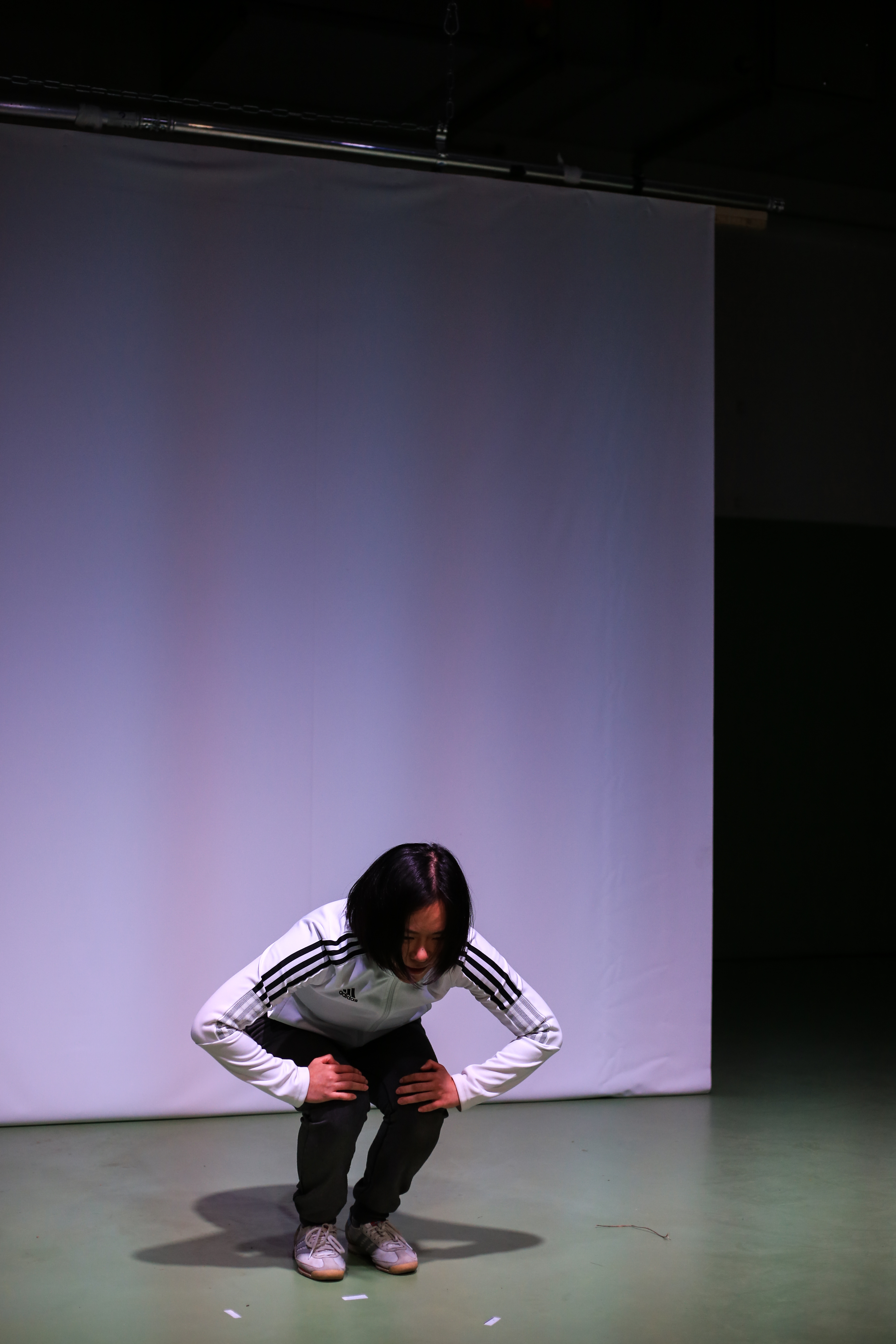
Rehabilitation is a stage performance based on research into Korea’s National Gymnastics. Originating from a fusion of European calisthenics and Japanese imperial military training, this form of gymnastics later spread to South Korea, Taiwan, China, and diasporic Asian communities. It became a tool of state discipline under military regimes and school systems, shaping the “ideal national body.” During the COVID-19 pandemic, it resurfaced as a viral YouTube trend, further amplifying its reach.
The performance reads its twelve movements as a clinical protocol — a body trained back into legible health, into a "collective" shape that conceals the wound it produces. As the national gymnastic counts repeat, the performer’s movements gradually falter, dissolve, and merge with noise. Here, rehabilitation does not signify full recovery. It becomes a process of reconfiguring and undoing a disciplined body, seeking new rhythms in the incomplete space between injury and repair.
Part 3. Chōri(조리/料理) Dance
In Collaboration with Maharu Maeno, Shuntaro Yoshida Performance on Stage, Stretching Sense festival at Tieranatomisches Theater, 45 mins
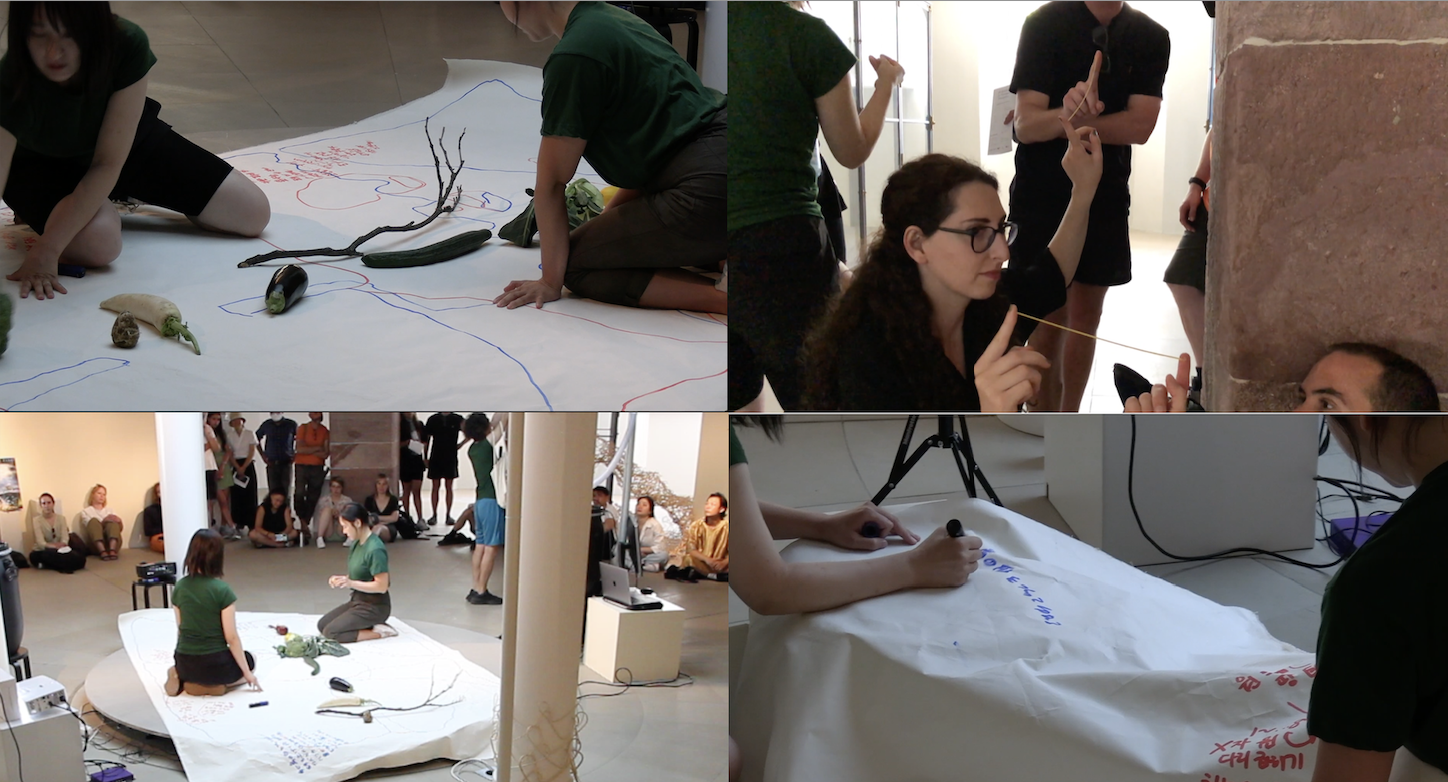
Chōri(조리/調理) is a word shared in Korean and Japanese, written with the same Chinese characters but pronounced differently depending on the body that speaks it. Unlike the term “Yōri(요리),” chōri emphasizes process over product. This 45-minute performance, created in collaboration with two Japanese performers, unfolds at the intersection of East Asia’s entangled modern histories and the ways in which Asian bodies move and dance. It marked the beginning of the ongoing Chōri Collective project.
Here, “cooking” becomes a metaphor for collaboration. Set on the circular stage of Berlin’s Anatomical Theater—once a space for dissection, now a symbolic map, a universe, a ship, or a pot—the performance choreographs the bodies of Japanese, Korean, and nonhuman agents in a shared process of chōri.
Within the stage, performers enact national gymnastics as a collective body, translating, repeating, and breaking it down through different languages and gestures. In this process, each body becomes an ingredient with its own flavor, fermenting together and disturbing the rhythms of colonial structures.